
Gamma-Ray Energy Tracking Array (GRETA)
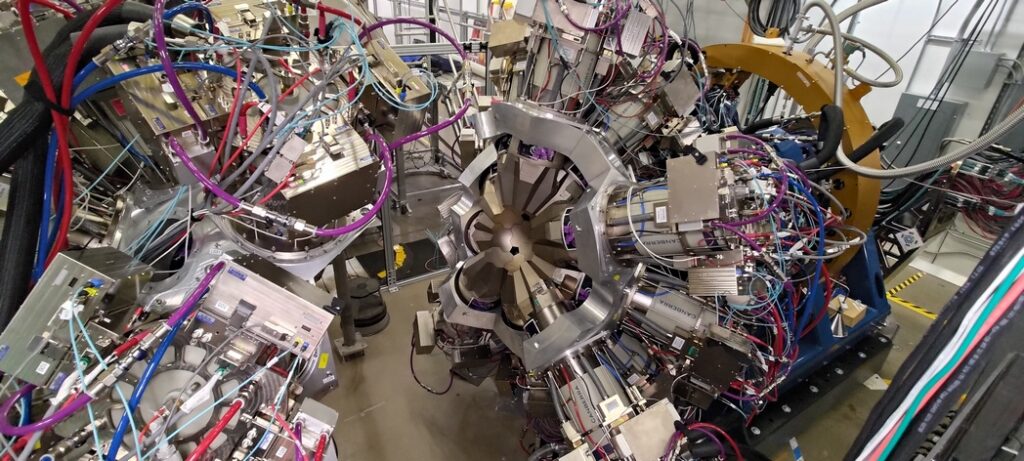
The Gamma-Ray Energy Tracking Array (GRETA) is the first realization of a 4𝜋 high-resolution gamma-ray detector array. GRETA was completed in 2026 and built by a team led by Lawrence Berkeley National Laboratory and including staff from Argonne National Laboratory, Oak Ridge National Laboratory and the Facility for Rare Isotope Beams. The array uses 120 large-volume high-purity Germanium crystals, electrically segmented into 36 segment volumes. The signals from each segment and the full crystal are digitized and processed to localize the individual interactions of gamma-rays in the detector to mm precision in all three spatial dimensions. Gamma-rays are then reconstructed based on the most likely scattering sequence between interaction points, allowing efficient rejection of background. GRETA’s detector, electronics and computing technologies combine to create the most sensitive gamma-ray spectrometer ever deployed.
GRETA is now starting operations with a scientific mission to study the structure and excitations of the atomic nucleus. Comprising 99.9% of the visible matter in the universe, nuclei are central to fundamental questions in physics, such as our understanding of the origin of the elements and how complex many-body quantum systems organize. Their properties depend sensitively on the number of protons (Z) and neutrons (N), and much of what we know about them comes from the measurement and characterization of their excitation modes, energy levels, and decays. High-resolution gamma-ray spectroscopy is one of the most sensitive and powerful techniques to study nuclear structure and decays.